
If interested, please contact Dr Veeranoot directly at her email below. We have fully sponsored the RM80 for this neutering. This sponsorship comes from all donors from our Medical Fund (RM40) and Berjaya Cares (RM40). Dr Veeranoot has very graciously redonated the RM80 to our Medical Fund to help other animals. Thank you!
From: Veeranoot Nissapatorn <nissapat@gmail.com>
Date: Thu, May 16, 2013 at 10:08 AM
Subject: Thong-loeng—a CH cat for neutering and adoption
To: Chan Kah Yein <chankahyein@gmail.com>Dear Sis Chan,On December, 2013, a 6-months- old disabled kitten named Thong-loeng was rescued and was later sent to the vet clinic for medical check-up. He was highly suspected of having toxoplasmosis after blood test was done. Antibiotics and supplement were then given to treat his condition. However, there was no sign of improvement even after the initial 2 weeks, then 4 weeks and finally 6 weeks of complete medication. Thong-loeng has also been given 2 doses of vaccination as recommended by the vet.The vet later confirmed that Thong-loeng was suffered from parvovirus infection since birth through his pregnant mother which led to his condition called “cerebellar hypoplasia (CH cat)”. I went through details of his condition to assist his daily life e.g., feeding, toileting, etc.A wheelchair is suggested to help his movements; however, this idea was aborted after consulting Lydia, a physiotherapist for disabled animals. The reason is he looks pretty much comfortable and is able to cope with his routine both functionally and mobility. Thong-loeng was sent to the vet for neutering on 14 May, 2013.I highly appreciate if a potential adopter who is willing to provide Thong-loeng a forever home with much love, care, and most importantly understanding his condition as a CH cat.Any amount for this neutering subsidy from AnimalCare Society will be donated to the medical fund “In Loving Memory of Kwanchai”.Thank you for the opportunity and hope you can kindly consider this request.
Sukhi Hotu!
Nui
After meal.
At home.
At clinic.
Neutered.
Playing with kittens.

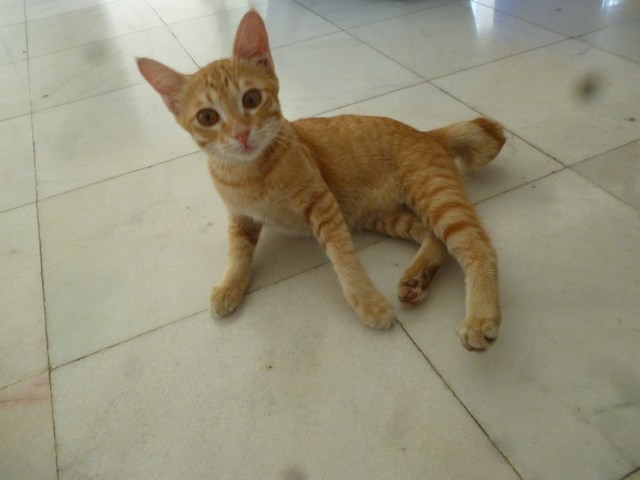
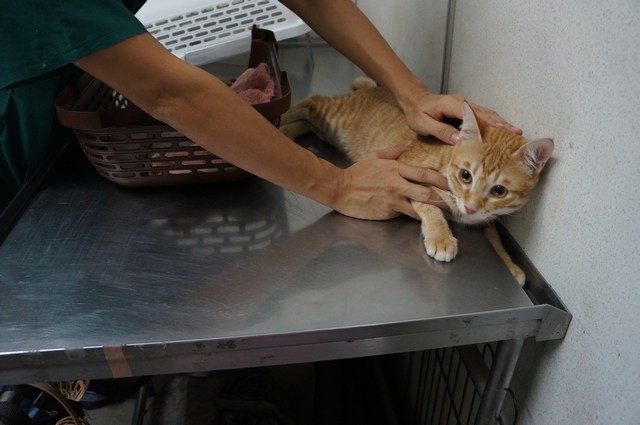
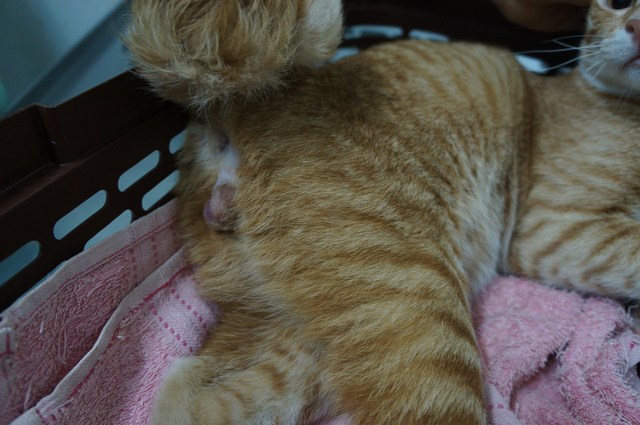

About cerebellar hypoplasia: http://lifewithchcats.com/what-is-cerebellar-hypoplasia/
Feline cerebellar hypoplasia is a non-progressive, non-contagious neurological condition that results in walking and balance problems.
A kitten is born with “CH” when her cerebellum, the part of the brain that controls fine motor skills and coordination, is underdeveloped at birth.
An cerebellum’s growth can be stunted by a number of factors, most commonly if the mother contracted the feline distemper virus while pregnant or if there was some sort of trauma to the kittens while they were in the womb.
Consequently, an underdeveloped cerebellum can result in underdeveloped or complicated mobility. CH cats are known for their “drunken sailor” walk, which is why they’re known endearingly as “wobbly cats.”
The severity of a kitten’s CH can vary greatly — even among litter mates. While some cats may only have a slightly impacted gait, others may have significant trouble getting around, if they’re able to walk at all. It’s important to remember that the cat isn’t sick, weak or hurt; she’s simply uncoordinated.
CH cats may also experience head tremors, the uncontrollable shaking of the cat’s head when she’s trying to focus. Again, some cats may experience mild cases, others may be more severe. (Consequently, some think CH cats may have vision issues. If you think this is an issue with your cat, speak to your vet.)
Unless a CH cat has other health issues, her life expectancy is the same as a cat’s without CH. Since the condition is non-progressive, it will never get worse — and in some cases, owners say that their cat became more capable over time.
A CT scan or MRI is the only way to officially diagnose cerebellar hypoplasia; however, many vets are familiar with the symptom’s characteristics so those tests are often not necessary. Yet it is important to understand there are some diseases and conditions that may mimic CH.
One of the great things about CH cats is that they don’t seem to know that they’re any different from other cats. Even though they may think they’re normal, depending on the severity of their CH, they may be somewhat limited in ability and learn how to do things differently. For example, some CH cats don’t have the coordination to jump – so instead they become great climbers. Consequently, CH cat owners may find ways to help their cat become more capable. You can find more topic-specific help here.
Click this video to watch a fantastic video about a CH cat named Charley.
There isn’t a treatment for this condition; however, many owners will tell you that there doesn’t need to be one. They’ll say their CH kitties are some of the sweetest cats you’ll ever meet, and what they lack in coordination they make up in personality. You can read their stories here. And if you’re not convinced, here are10 reasons why you should adopt a CH cat.
Since many people are still learning about this condition — and because some shelters don’t adopt out special needs animals, many kitties with CH are needlessly euthanized every year. While it’s not an extraordinarily common condition, cats with this condition do require a special owner who’s devoted to providing the best care possible for the cat.


Comments
2 responses to “Neutering sponsorship for Thong-loeng, a rescued CH male cat, also for adoption (Dr Veeranoot Nissapatorn’s)”
Hi, is the cutie pie still available for adoption?
Could you please contact Dr Veeranoot directly? nissapat@gmail.com