
The other day, I chanced upon this amazing website and the dentist, Dr Ellie Phillips: https://drellie.com/
She has been a dentist for 50 years now and her advice is nothing like what I’ve heard from the many dentists I’ve consulted all my life.
So, if you are interested in dental health, do take some time to listen to her videos. I did, and proceeded to look for a Xylitol mouthwash, and my brilliant pharmacist has one!
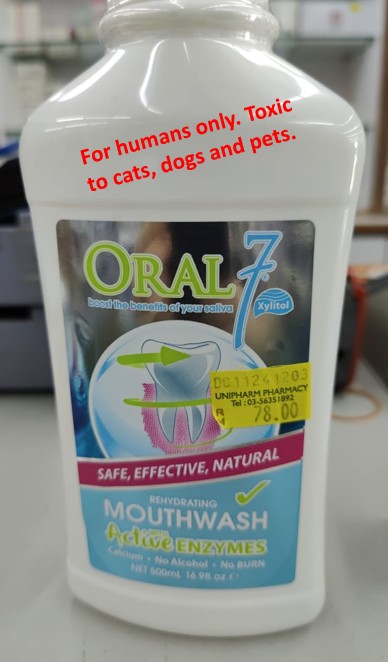
It IS rather pricey, but if it works to prevent plague, why not, right?
Dental health is so, so important, especially for me, because I have mitral valve regurgitation (that’s a floppy mitral valve discovered when I was 17 years old).
The short explanation: People with mitral valve regurgitation should maintain good dental health to prevent bacteria from spreading to the heart valves. This is because bacteria from infected teeth and gums can cause endocarditis, a rare but potentially fatal infection of the heart’s inner lining.
I chose not to opt for any medical intervention on my defective valve. I was 17 years old then when the specialist told me about it. I didn’t even inform my parents, actually, as I’d decided I would just live with it. But it did solve the mystery of why I could never do vigorous sports throughout my school life and could only walk and swim.
It’s been 45 years now. But I really have to take special care of my dental health which I’m guilty of neglecting for decades when life whizzed by too quickly.
So, it’s about time!
Disclaimer: Please find out the side effects and negative effects of using Xylitol (yes, there are some). Always consult your dentist for professional advice. This is only a sharing.
Xylitol is a natural sugar alcohol found in plants, including many fruits and vegetables. It has a sweet taste and is often used as a sugar substitute. Xylitol tastes sweet but, unlike sugar, it doesn’t cause tooth decay.
Unfortunately, Xylitol is toxic and deadly to cats. So, that’s completely out for cats. Please do not use it. And if you are using it for yourself, when you spit out the gargle in the sink, be sure to wash it all away so that your pet won’t accidentally lick it. Xylitol is a type of carbohydrate with similar chemical structure as sugar and tastes “nice”, it is found in chewing gum and candies too.
Now, talking about gum disease and bad teeth, our last batch of cats had this problem. It was quite impossible to brush their teeth and products like Orozyme actually did not work. Of course the vet advised to put them through scaling (under sedation) and I did that. But I noticed that after scaling, the problem would just come right back.
A friend (who has the knowledge) told me now to put our animals through scaling because he said scaling would remove the protective layer on the enamel and cause even more problems. I was in two minds then, because in their senior years, our cats needed the dental treatment and I know for a fact that poor dental hygiene would lead to the body producing globulins. Globulins destroy the kidneys.
Vincent was our first former street cat with CKD. Even before he had CKD, the senior vet already said he needed dental extraction (bad teeth) and Vincent actually had two rounds of dental extraction. The senior vet also forewarned me that Vincent would eventually end up with CKD which would be terminal. He had already prepared me (he doesn’t mince his words). Vincent came from the street, and I did not know his background.
What the vet predicted came true, exactly.
So, after nursing Vincent through CKD and after his passing, I took all our cats (yes, every single one) to the vet’s for a dental check-up. Our males needed tooth extraction and scaling. That would be Cow Mau, Bunny, Indy and Ginger. The females didn’t need any. So, our boys had their bad teeth extracted and scaling was done. But for Cow Mau and Ginger, they both needed another round of scaling later. Cow Mau was already very senior too. But his mouth pain was so bad, we had to make a judgment call for that scaling. He survived it, but the mouth pain came back very quickly. I did not subject him to a third scaling or extraction anymore. We coped with the mouth pain. It wasn’t easy (you might remember).
At one time, Pole was discovered with “very bad teeth” and another vet insisted on putting her under to remove that “very bad teeth”, but luckily I took her back to our (then) senior vet. Would you believe it? He stuck his finger into Pole’s mouth and scratched out the tartar. “What bad teeth?”, he asked me, and showed me the tartar he had scratched out!
So, Pole was spared from a scaling.
Now, I know Tabs has tartar, but I am not putting her through scaling since Tabs already has PCKD and we are giving her palliative care for it. I was told Gerald also has dental problems but he has just been through a trying time with those deep wounds inflicted through a purported fight with “someone” on the street, so I am really undecided if he should go through general anaesthesia for scaling. What if my friend is right and scaling really does remove that protective layer on the teeth and weakens their teeth?
I am very undecided.
I have opted for RC’s Dental kibble too, but does it work? Some of our cats actually swallow the large kibble whole and it causes them to vomit later on. I’ve use Orozyme without much success and one vet told me he doesn’t think it works either. Greenies has too much wheat, I’m told.
We have to brush our cats’ teeth, I suppose that’s the only way, and I am guilty of being unable to do a good job at that. Perhaps I should try harder. And perhaps I should just use Orozyme again. Something is better than nothing?