
Our vet searched and found that chitosan oligosaccharide has been documented to help in PKD (polycystic kidney disease) which is what Tabs has. In short, PKD is a condition whereby there are many cysts in her kidneys and these cysts will take up space in her kidneys thereby destroying her kidney cells. Because of this, Tabs also has Stage 2 CKD. PKD is a genetic disorder.
I also found this:
The journal article: https://www.ncbi.nlm.nih.gov/pmc/articles/PMC7730275/
From the article:
Chitosan oligosaccharide (COS), a natural polymer derived from chitosan, exerts several biological activities including anti-inflammation, anti-tumor, anti-metabolic syndrome, and drug delivery enhancer. Since COS is vastly distributed to kidney and eliminated in urine, it may have a potential advantage as the therapeutics of kidney diseases. Polycystic kidney disease (PKD) is a common genetic disorder characterized by multiple fluid-filled cysts, replacing normal renal parenchyma and leading to impaired renal function and end-stage renal disease (ESRD). The effective treatment for PKD still needs to be further elucidated. Interestingly, AMP-activated protein kinase (AMPK) has been proposed as a drug target for PKD. This study aimed to investigate the effect of COS on renal cyst enlargement and its underlying mechanisms. We found that COS at the concentrations of 50 and 100 µg/mL decreased renal cyst growth without cytotoxicity, as measured by MTT assay. Immunoblotting analysis showed that COS at 100 µg/mL activated AMPK, and this effect was abolished by STO-609, a calcium/calmodulin-dependent protein kinase kinase beta (CaMKKβ) inhibitor. Moreover, COS elevated the level of intracellular calcium. These results suggest that COS inhibits cyst progression by activation of AMPK via CaMKKβ. Therefore, COS may hold the potential for pharmaceutical application in PKD.
Our vet says to start with one-third capsule twice a day first (this would be 200mg because 1 capsule contains 600mg of chitosan oligosaccharide). This information is found in the Veterinary Information Network (200mg twice a day). Since Tabs is also on Renal-P and this also has chitosan but in a small quantity. For Tabs’ dosage of Renal-P, she’s only getting 80mg of chitosan per day through Renal-P. Note that Renal-P has chitosan and not chitosan oligosaccharide.
Not to be confused, the recommendation of chitosan for PKD is 200mg per cat twice a day whereas the dosage of the same supplement for the purpose of phosphate binding is 200mg/kg. There is a huge difference here and we are using it for PKD, not for phosphate binding.
What is chitosan oligosaccharide?
The frequently studied polysaccharide, chitosan oligosaccharide/chitooligosaccharide (COS) is the major degradation product of chitosan/chitin via chemical hydrolysis or enzymatic degradation involving deacetylation and depolymerization processes.
What is the effect of chitosan oligosaccharides?
It has been proved that chitosan oligosaccharide (COS) has a more favorable therapeutic applications such as wound healing and anti-tumor treatment, and can affect angiogenesis.
Anyway, my kind pharmacist helped me source for the chitosan oligosaccharide (not just chitosan alone) and I ordered it on the same day after our vet says all the other ingredients are safe and this product should be okay.
It arrived today, from iherb.com.
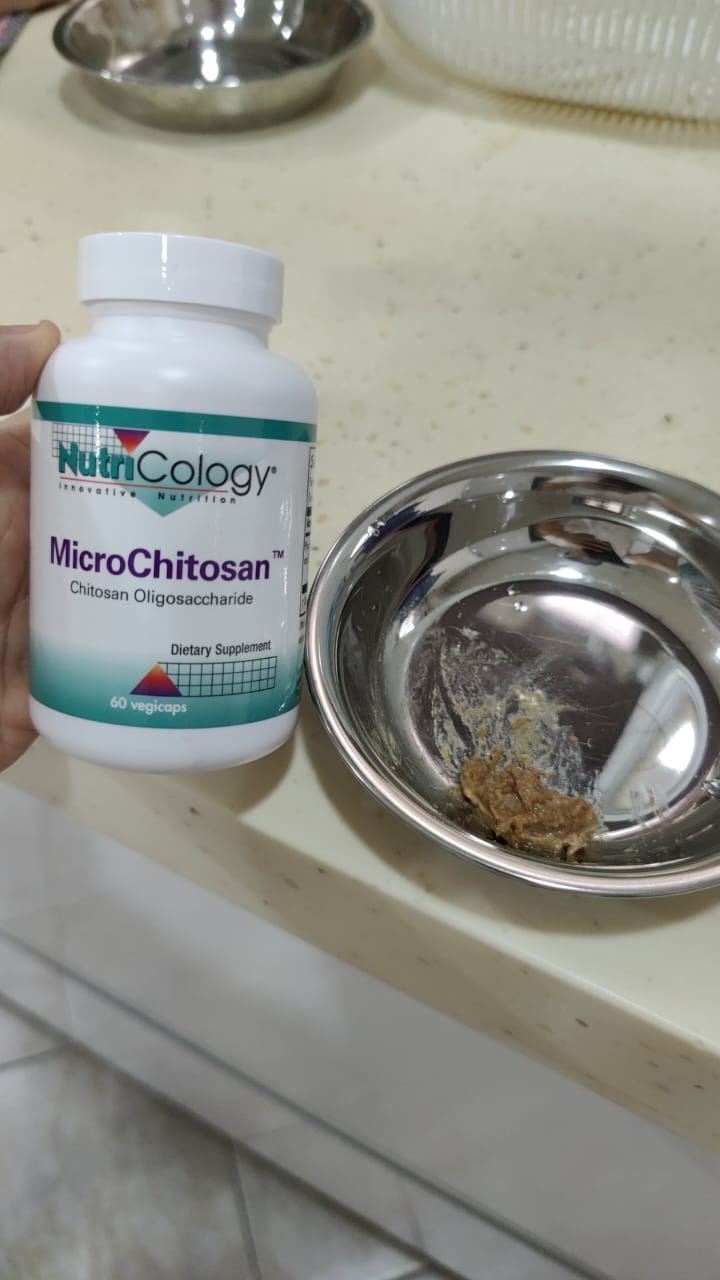
That’s one-third capsule of powder mixed with Hill’s KD wet food.
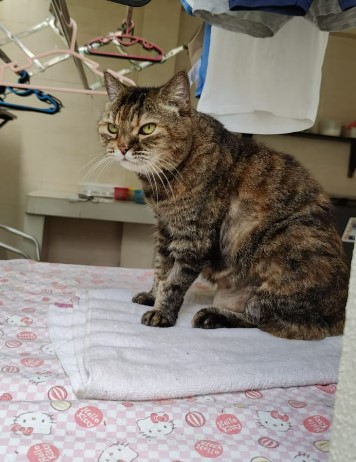
That’s Tabs after being fed the mixture. She’s quite fed-up. What is this? I thought I’m done for the morning?
Disclaimer: This is only a sharing. If your pet has a similar ailment, please consult your veterinarian and do not give any supplement unless it is approved by them. Every pet is different.
The article above mentions AMPK. Here’s something from the internet about it:
AMP-activated protein kinase (AMPK) is a phylogenetically conserved fuel-sensing enzyme that is present in all mammalian cells. During exercise, it is activated in skeletal muscle in humans, and at least in rodents, also in adipose tissue, liver and perhaps other organs by events that increase the AMP/ATP ratio. When activated AMPK stimulates energy generating processes such as glucose uptake and fatty acid oxidation and decreases energy consuming processes such as protein and lipid synthesis. Exercise is perhaps the most powerful physiological activator of AMPK and a unique model for studying its many physiological roles. In addition, it improves the metabolic status of rodents with a metabolic syndrome phenotype, as does treatment with AMPK activating agents; therefore, it is tempting to attribute the therapeutic benefits of regular physical activity to activation of AMPK.
Source: https://www.ncbi.nlm.nih.gov/pmc/articles/PMC2779044/
Tabs is a very sedentary cat by nature and hardly exercises.