
This is a very long blogpost, meant for readers who haven’t been following us from the start, in 2009. If you have, please just skip the first half and scroll right down to today’s feeding photos!
For those who are new to this blog (we are more than 15 years old), please allow me clarify that the purpose of this blog is to (1) report how funds are used for our aid packages (neutering, vaccination, medical, food), (2) share animal caregiving stories by ordinary folks like me.
I wish also to further clarify (2) that I am not a veterinarian nor a pet nutritionst, nor an expert in any area of animal caregiving. I am merely someone who chooses to care for animals in the best possible way that I can and all my sharing (and those of my friends) are merely experiencial barefoot knowledge.
It is also our hope that caregivers who are better qualified will also be willing to share their ideas and what they do so that it can be posted for the benefit of everyone to learn from.
Having said that, let’s zero in on cat nutrition today. We are what we eat.
I am not qualified to give any advice on cat nutrition. This is only a sharing.
Initially, all our cats ate a rojak of kibble, canned food and raw food. But in 2019, having been convinced of the benefit of raw food being the biologically-appropriate food for obligate carnivores like cats, I decided to attempt to convert all our cats to a 100% raw diet. My attempt took one month, and it was a success. Every cat was on a 100% raw diet, including our senior cats! I gave myself a pat on the back.
But as the years went by, our cats started growing older and they reached the stage of palliative care where appetite was a concern. At this stage, I decided that if they no longer liked raw food, that’s okay. So I purchased canned food, make my own cooked food and even purchased kibble again for them. My own principle of feeding for sick or elderly cats is: As long as you eat.
I am well aware of the raw food movement and how raw food proponents adopt the “eat raw or starve!” principle. That is their choice which I believe is done in the best interest of their cats. It is a choice of the caregiver. There is no right or wrong, in my opinion. I know of cats who thrive on kibble alone too, to a ripe old age too. Similarly, there are those who thrive on raw food. Some would only give home-cooked food to their cats, nothing else. To each their own, I say, we are all doing what we think is best for our pets.
I once attended a short course by a veterinarian and pet nutritionist (qualified in both). She explained the benefits of raw food for cats. But she also said that raw food may not be suitable for every single cat. So for those who cannot take raw food for any reason, she gives them cooked food (canned food). And once a week, all her cats get a night of kibble as their “tv snack”!
I thought this was a practical idea. I liked it. I also met another caregiver who has a lot of experience in cat caregiving. She gives her cats raw food, but she exposes them to cooked/canned and kibble because she believes “the rubbish strengthens their stomach”!
In purchasing canned food and kibble, it is important that we read the ingredients list. This will help us decide which brands are suitable for our cats’ specific needs. The same goes for commercially-available raw food too. Any brand can claim that theirs is “the best”, but that’s for you to decide. Or better still, for your cats to decide!
Some time last year, I realised that after having past the age of sixty, it is important to make plans for all my cats because mortality increase with age. Just as we make plans for our human dependents, we must also make plans for our pets. So two kind friends agreed to be “godmothers” for all my cats (at that time). As it stands now, all our current cats have godmothers except for Juno (she’s new). The godmothers will take over the cats when I die. But I hope I outlive all our cats so that I can see them through their natural lives. Hence, the need to live for another 20 years!!
Because of the above, I saw it practical to train our cats to be able to eat raw food, canned food as well as kibble again. Although this isn’t a “perfect diet”, it is a practical one for my own personal limitations. If our cats go to their godmothers, surely I do not expect them to feed them a 100% raw diet. I won’t take advantage of their kindness and impose this restriction on them.
So, a few months ago, I started buying kibble and canned food again. Our cats would get all three types. Not perfect, I know, but it’s practical. Moreover, it had to be done because the Blondies, even though raised from birth on only raw food, showed a clear preference for kibble now. I believe cats know what’s best for them so I respect that.
Isn’t it fortuitious that I did that because I landed up in hospital for 4 days this time, most unexpectedly!
The night I was told I had to be admitted because I was already in a pretty serious state of pneumonia, I worried for our cats. Who’s going to feed them?? Luckily, our cats have been trained to eat all kinds of foods. So, with whatsapp texting, I was able to guide my husband on how to feed our cats during the 4 days that I was away. He’s actually never fed them before, it had always been me.
Initially, he said he would only feed them kibble and nothing else. But later, he relented because he knew I placed a lot of importance in raw food, or at least, wet food. So he tried too and I must say he really did a superb job! I know how choosy some of our cats are, I also know they are bullies! I know who likes what but that is only because I feed them on a daily basis.
I published photos of my husband’s trials during meals times (more as a funny anecdote) but it seemed this has now resulted in some confusion about the rights and wrongs of feeding cats.
So, please allow me to clarify here that whatever methods or choice of food we use to feed our cats stems from my own practical reasons, they are certainly not “the gold standard” on nutrition. If you are interested in learning about proper nutrition for cats, please do learn from the experts for which I certainly am not!
I hope this clarifies?
START HERE IF YOU ARE AN OLD READER
And now, for today’s stories….
Last night, after settling the hospital bill and getting my medicines, we returned home quite late. All our cats were so excited and also hungry. For convenience, I gave everyone Monge kibble. All our cats love Monge!
Later in the night, I gave everyone canned food. They sapu habis!
I had to check the fridge for whatever raw food that has been thawed as I had been away for 4 days. I needed to determine if they are still fresh. The thing with raw food is that it’s important to maintain its freshness. I keep them frozen, and thaw thaw them in the fridge and once thawed, I use them up within 24 hours. Otherwise, raw food spoils fast and pathogens will fester.
This morning, I threw away the raw food which didn’t look fresh anymore and am now only using the raw food that is fresh. So, it’s just newly-thawed Cubgrub and a bit of Coco&Joe’s.
We are using more Cubgrub now mostly because of Juno’s coccidia infection (highly likely acquired from raw food). Cubgrub does not use the intestines; that’s where the concentration of coccidia is found in raw meat. Some in the liver too. The founder of Cubgrub, who is also my friend, was actually willing to customise my order to exclude liver and eggs just for Juno, but I didn’t want to trouble her. Actually, the vet said not to give Juno any raw food because she seems to have a problematic stomach. But I’m sneaking in some Cubgrub for her. I think it’s safe. It’s my call. That is because I know the exact ingredients of Cubgrub. It follows Dr Lisa Pierson’s recipe to a t. Cubgrub is very open to revealing its exact recipe and nutritional analysis to its customers so that they know what they are feeding their cats.
And the vet also advised me to consider giving Ginger only cooked food because he’s getting on with age and he is FIV+. Ever since then, Ginger has been getting home-cooked food which I make myself and canned food. He still gets raw once in a while. Again, it’s my call.
The protein in cooked food is broken down, making it easier for it to be digested for certain cats who might have gastro-intestinal issues. Not all cats are equal and alike. Raw food claims to contain enzymes that help with digestion, so do your own research and take your pick. Also, some canned food are complementary food, not complete. Read the labels.
Let’s see now….who ate what this morning?
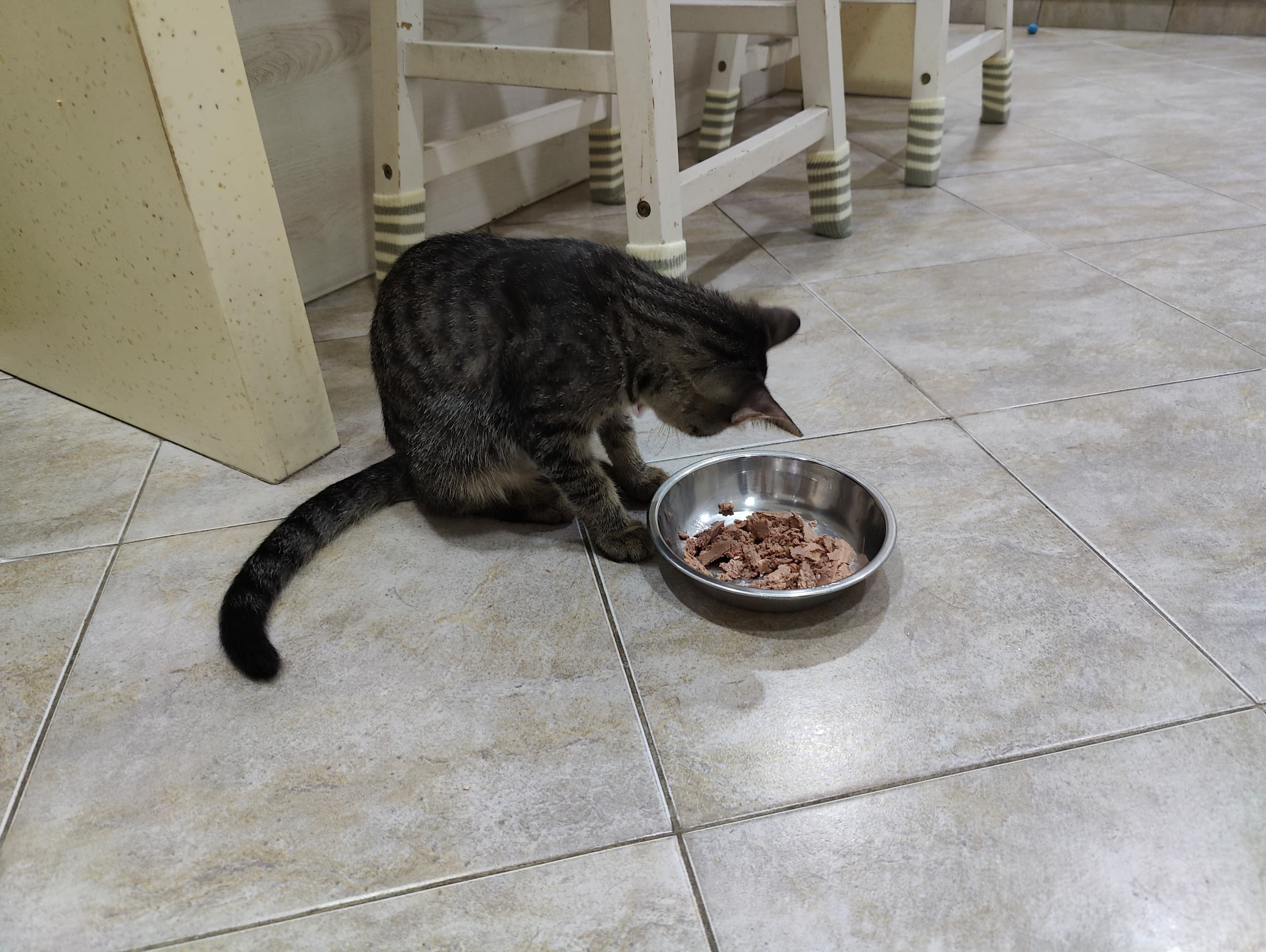
I gave Juno Fur/Ball cooked food.
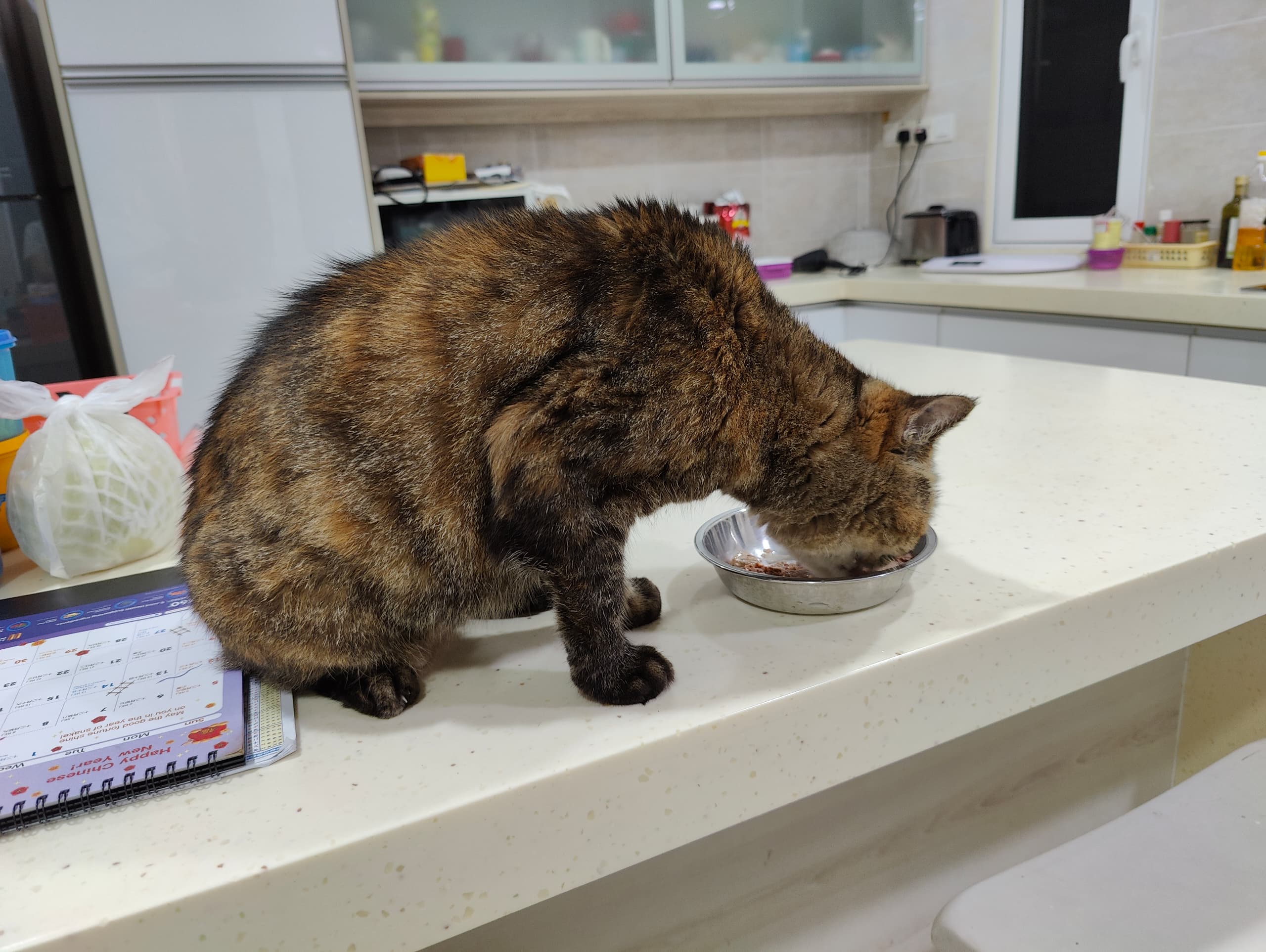
Tabs also had Fur/Ball.
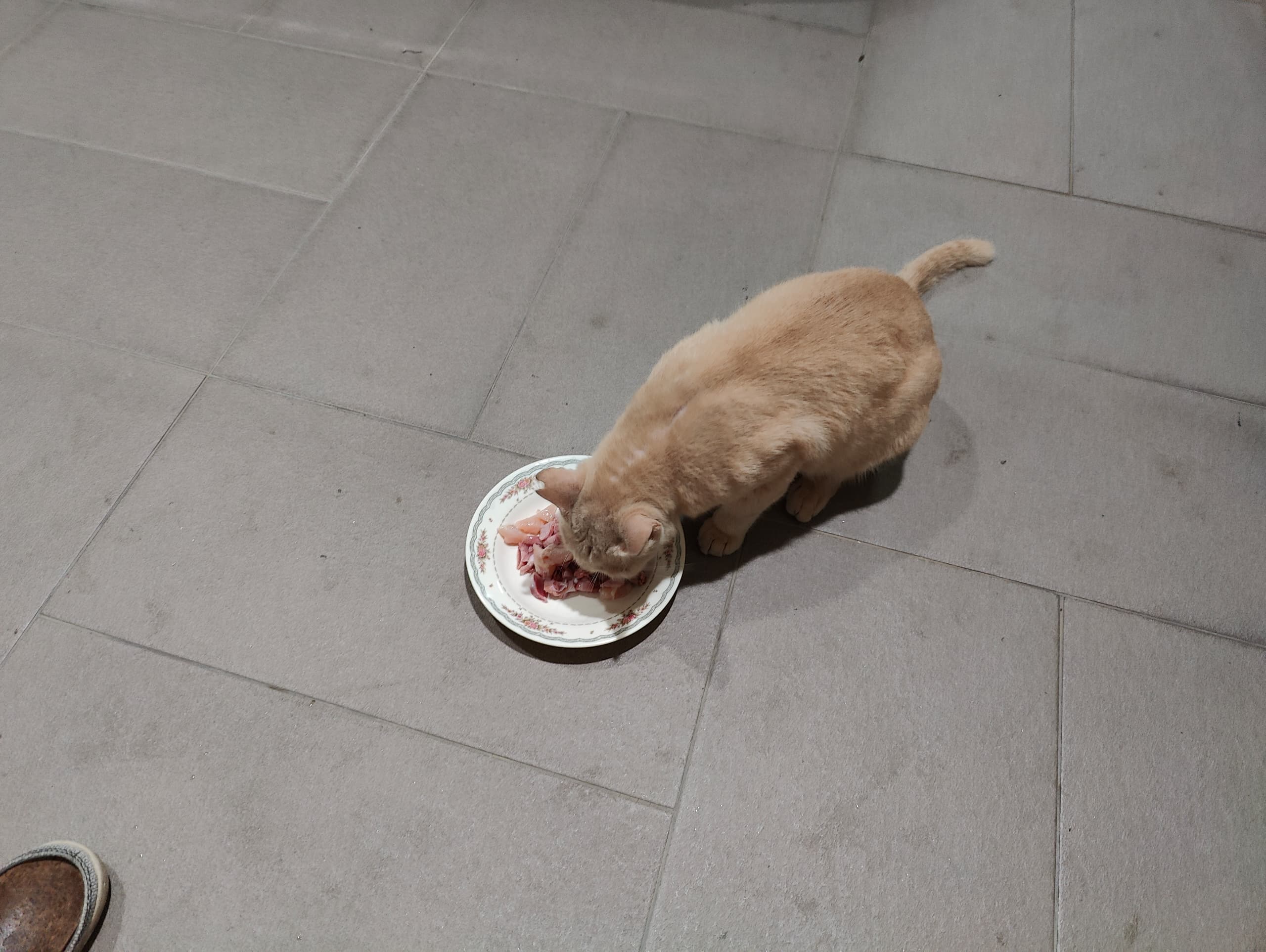
Creamy has his Coco&Joe’s, gizzards and cut chicken. In fact, nowadays, Creamy is the only cat who likes Coco&Joe’s. The rest have staged a boycott on it. Cats!!
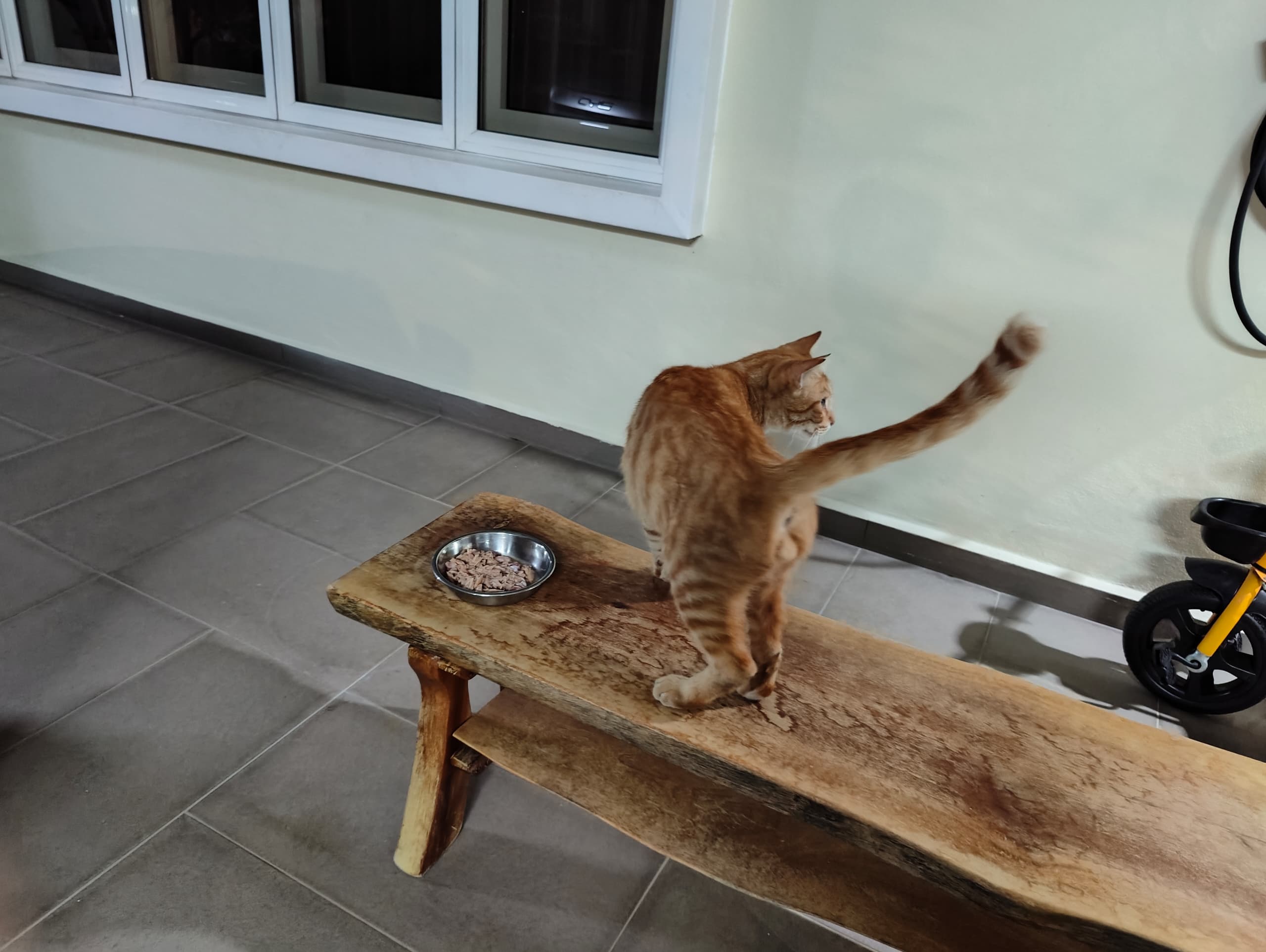
Gerald had already asked me for food at 1am but he’s here again.
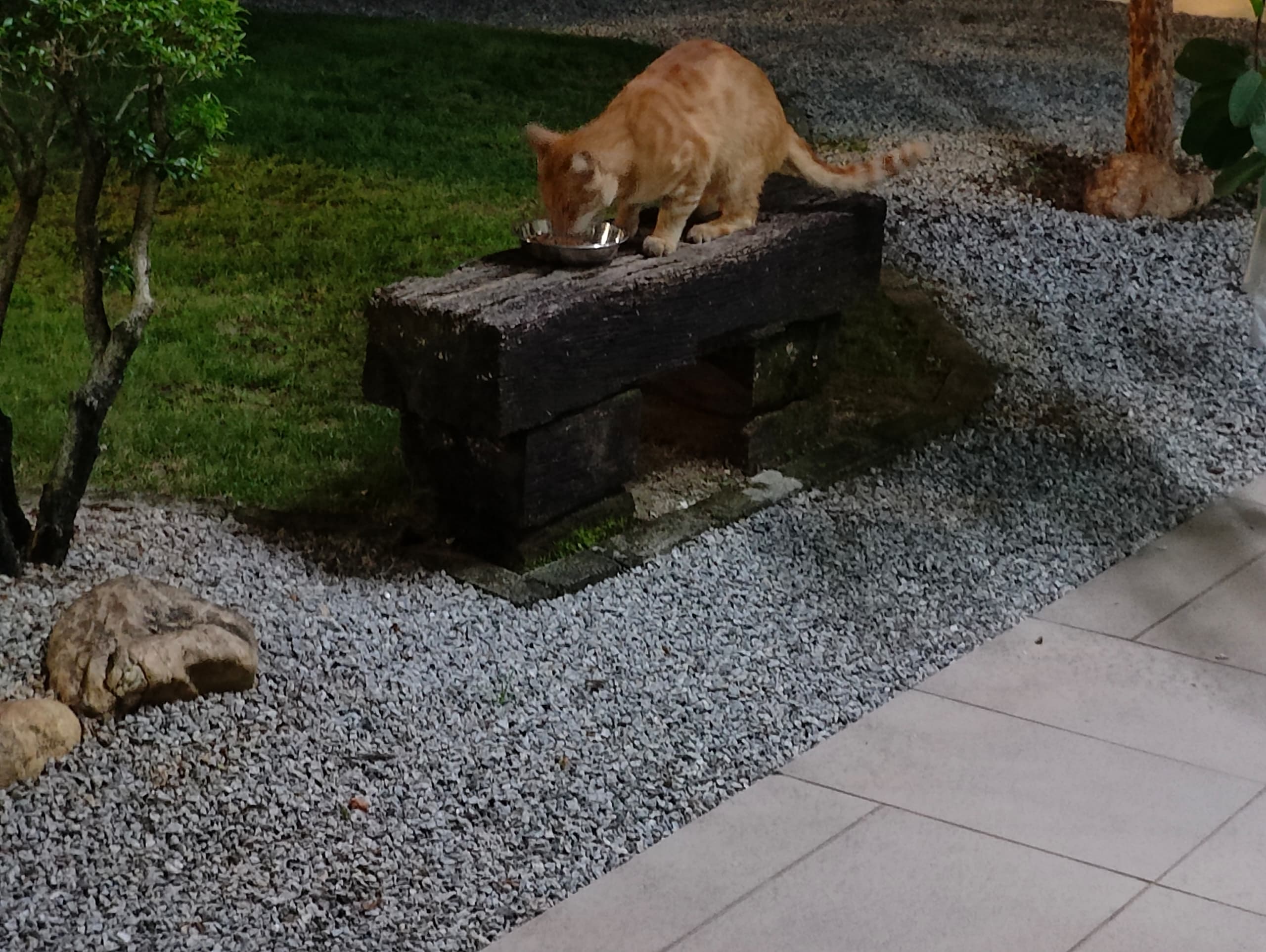
He did not eat much.
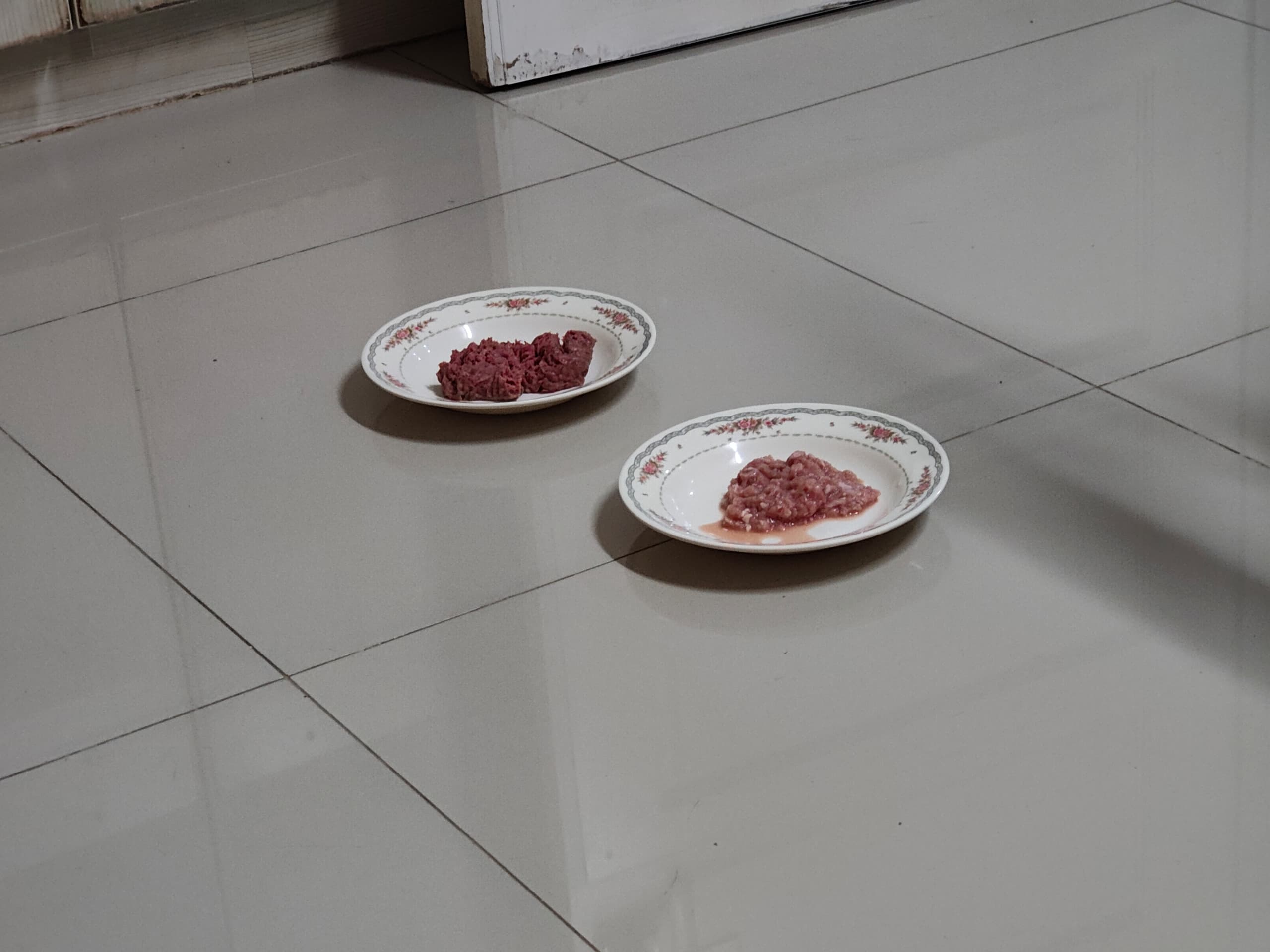
Enticing the Blondies to eat some raw food; a plate of Coco&Joe’s and a plate of Cubgrub. They came, they sniffed and they all went away.
So, the plates went to the Monsters.
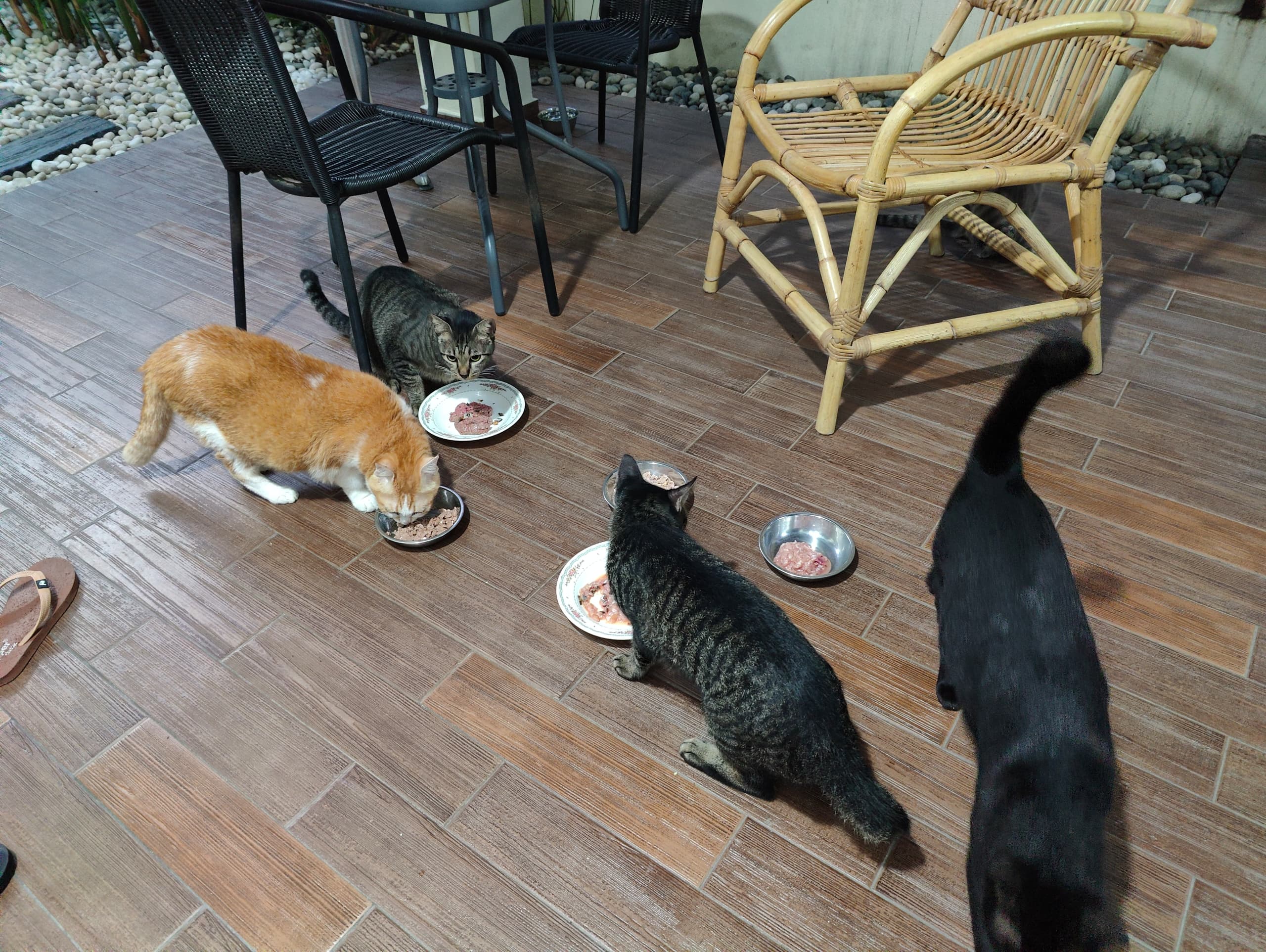
The Monsters were offered a buffet of various kinds of food which included raw food and cooked food. No kibble.
I may sometimes use some grainfree kibble as toppers to make them clean up everything. It is generally not advisable to mix kibble with canned/cooked or raw food. The reason is that kibble is high-carbohydrate while canned/cooked/raw is high-protein. It is believed that the cat’s digestive system produces different enzymes to metabolise carbohydrates (at pH 4) and proteins (at pH 1). Due to this difference in the pH values, there might be gastro-intestinal issues or other problems. However, this theory may not be backed by science. In any case, if I do use kibble as toppers to make them eat up their raw or canned food, I only use grainfree kibble and only a very small amount because grainfree kibble has a lower content of carbohydrates.
Nowadays, I use shishamo treats as toppers. This is protein so the above will not apply.
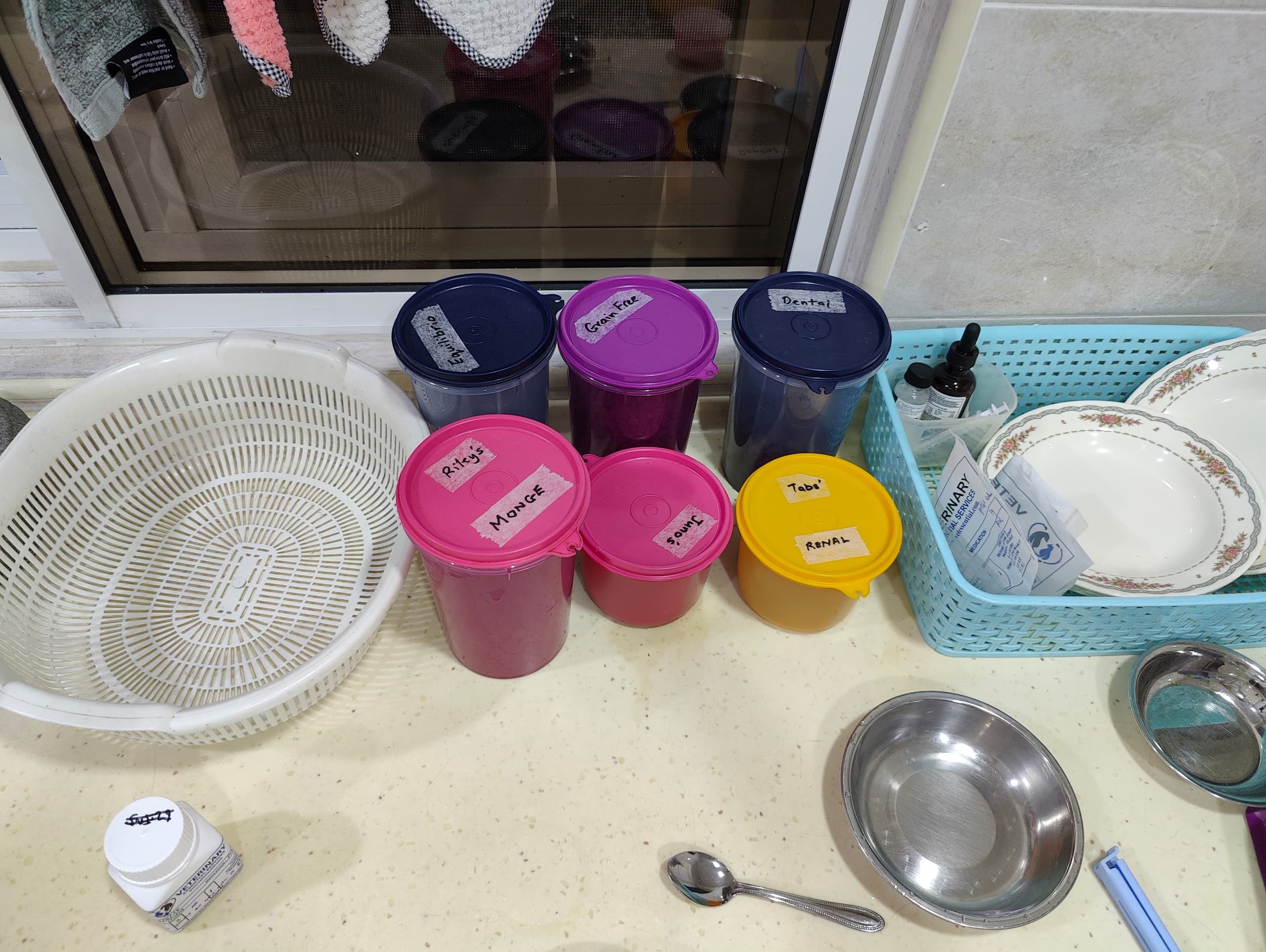
Luckily I had already labelled all our kibble before I was hospitalised, so I could tell husband exactly which to use for what purpose. Husband found out, as did I, that every single cat loves Equilibrio and Monge kibble. Of course they do. Both contain grains. Are grains really unsuitable for cats? Generally, cats should be eating protein, not grains. But why do they like kibble with grain so much? Ah…it could be the palatants that manufacturers put in the kibble.
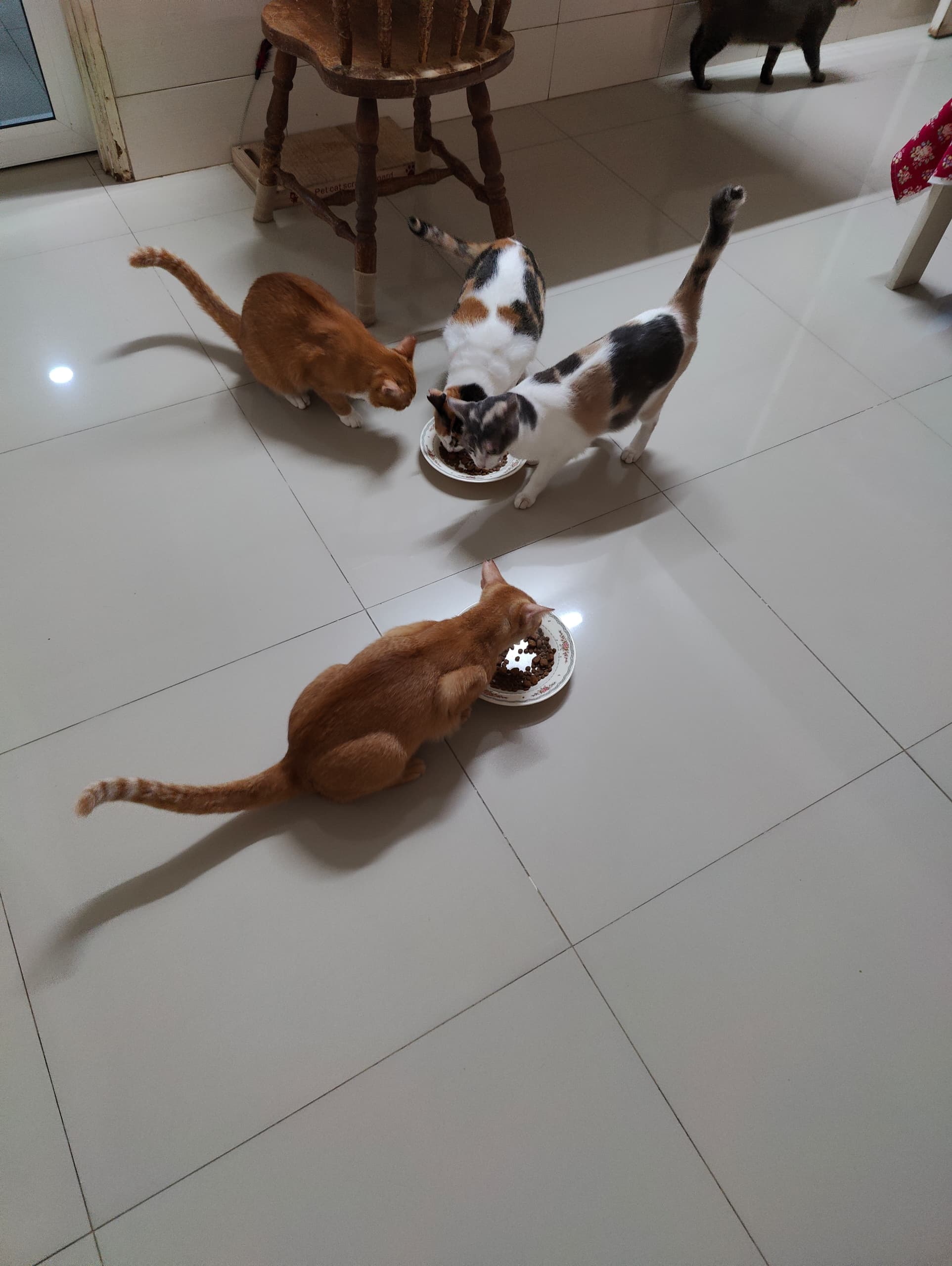
Since the Blondies did not want raw food today, I gave them kibble. Oh well, as long as you eat something and don’t starve. The argument against kibble is that it is ultra-processed and dry, hence, not natural. Some contain a lot of additives, some use low quality protein sources, and the list goes on. But what would you do if your cat simply refuses to eat anything but kibble?
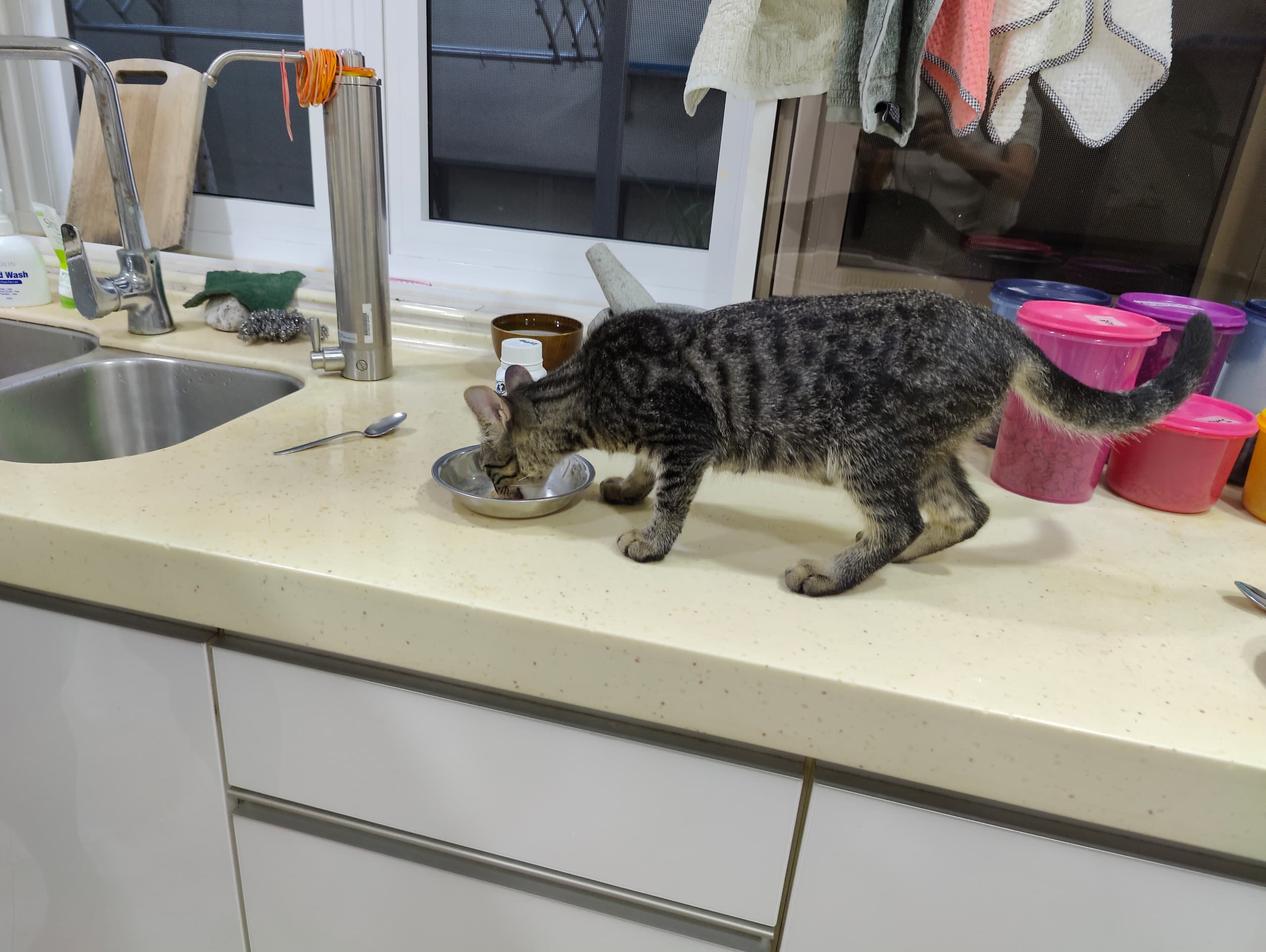
Juno’s supplements of Feline Gut Soothe and Pro-Fibre.
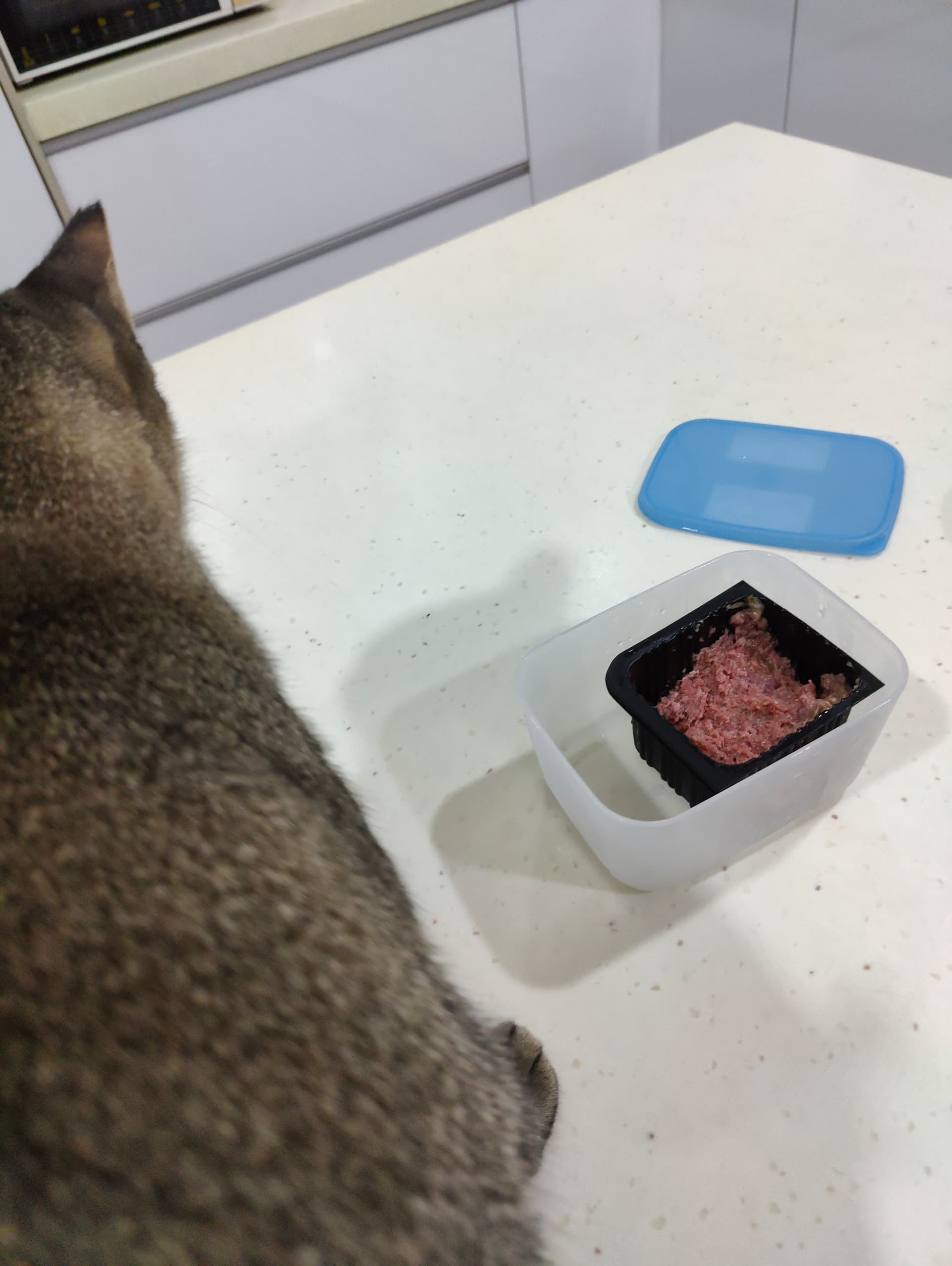
I have always force fed Riley Coco&Joe’s because it’s very hard to get her to eat it herself. This is to ensure she has some raw food. Given a choice, Riley prefers to nibble on kibble all day long. Like a goat!
I hope the information in this post is somewhat helpful for new readers. That said, if you need nutritional advice for cats (or dogs), please consult the experts. We are not qualified!