
I miss Ginger and Tabs so, so much.
There is no more subcut to do each morning, no more medicines and supplements to feed. No more cleaning of Tabs’ special litter box. It was additional work every morning and I miss it so much. I miss them both.
Yesterday, I cleaned out the containers for Tabs’ supplements. I threw away the unfinished bottle of subcut fluids. It feels so empty now that our subcut station doesn’t have the familiar bottle of fluids which have hung there for so many years, because all of elderly cats needed subcut, some for years before their end-stage.
For Ginger and Tabs, I decided to minimise veterinary intervention for their end stage. Just focus on comfort care, no need for more diagnostic care. Was that the right and compassionate decision? On hindsight now, I think it was.
But the palliative care for each one was clearly quite different, which drives home the point that every cat’s needs is different and we really have to play it by ear.
Ginger’s demise was primarily caused by the sudden rapid progression of the FIV. He became anaemic. It wasn’t his kidneys at all. Ginger went through stemcell therapy for his kidneys in January 2024 and his Stage 2 was reversed to Stage 1. So his kidneys were all good, and it was the FIV which suddenly wreaked havoc. Tabs’ was caused by the genetic polycystic kidney disease, but she was surprisingly okay for so long with great appetite until it suddenly went down. Tabs also had stemcell therapy in January 2024 but that did not help with the PKD.
Ginger was a very decisive and stoic cat. He decided to stop eating and he seemed fine with it. I read that once the organs begin to shut down, there is no more thirst and hunger, and that it isn’t a painful process. The cat just feels like sleeping more. I also read that if the breathing is slow and calm and there is no open-mouth breathing, it means the cat is comfortable and at peace. Ginger was at peace throughout. But I did give him the Gabapentin (painkiller) and I continued the daily subcut so that he would not be dehydrated. He didn’t even want me to moisten his lips with a wet cotton pad. So while we are able to get a whole to-do list, it’s all about trying gently to see what works.

Tabs was different. She had some issues. First, it was straining to urinate (or was it to defecate?). I could not let that carry on without veterinary intervention. Straining to urinate is very uncomfortable and stressful. Luckily Prazosin helped and the vet’s enema also helped. There was no more straining after that. Then, she had something growing at the back of her right eye until it was inflamed and the third eyelid was being pushed out. The vet said it was probably a tumour. Luckily again, the eye ointment did wonders and the inflammation subsided. All these needed vet intervention. I couldn’t just let it be just because she was at the end stage. It is all about comfort care and sometimes comfort care really requires a vet’s expertise and knowledge. For this, I’m so, so thankful to our vet.
Tabs was also on Gabapentin but the dosage was too high until her hind legs became very weak and she had ataxia as well. Lowering the dosage worked wonders, again, I would not have known this without the vet’s advice. Tabs also had subcut until a day before her demise.
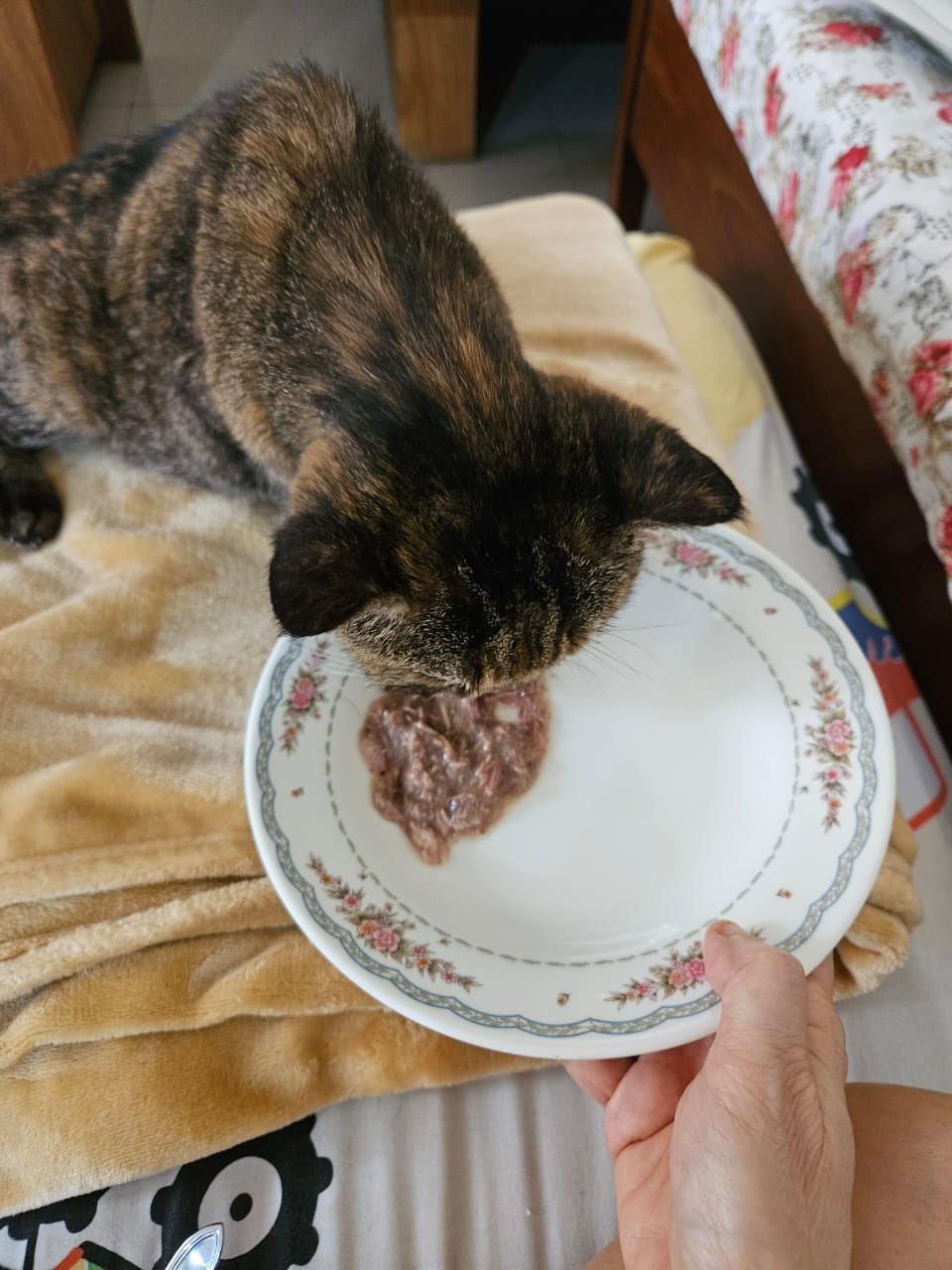
Tabs did not stop eating entirely. She was still interested in food, so I bought her all her favourite foods and offered a variety at each meal. There is an understanding or silent communication between Tabs and me, and she finds a way to let me know which food she felt like eating. But slowly, her appetite declined until she finally stopped eating too.
Unlike our previous cats, this time, for both of them, I respected their choice of not eating and did not force feed. When a cat doesn’t feel like eating anymore, force-feeding can be extremely stressful for both the cat and the caregiver. It can even be dangerous as it can cause choking or vomiting.
Giving palliative care is a challenging process. We get advice from a trusted veterinarian who respects our decision to administer palliative care, but ultimately, it is also about listening to what our cat needs from us. If we have spent enough time with our cat, somehow, we will be able to read their body language or their minds and know what they want.
They will find a way to tell us, and we must listen to them.
Leave a Reply